

Hybrid events combine in-person and online audiences into a single experience. It's not simply about pointing a camera and streaming: a well-executed hybrid event integrates both audiences with differentiated value propositions, unified ticketing systems, and operations that work seamlessly for both formats.
If you organize events in the US or anywhere globally, you've probably encountered this format. Conferences, workshops, festivals, product launches, academic congresses, and even theater performances have adopted the hybrid model as a permanent strategy, not just as a pandemic backup plan.estrategias de marketing específicas
The important question isn't whether hybrid events are trending. The question is how to sell them effectively, how to avoid the mistakes most organizers make, and how to choose the right tools so your operations don't unnecessarily double.
In-person vs. online vs. hybrid: when each format works best
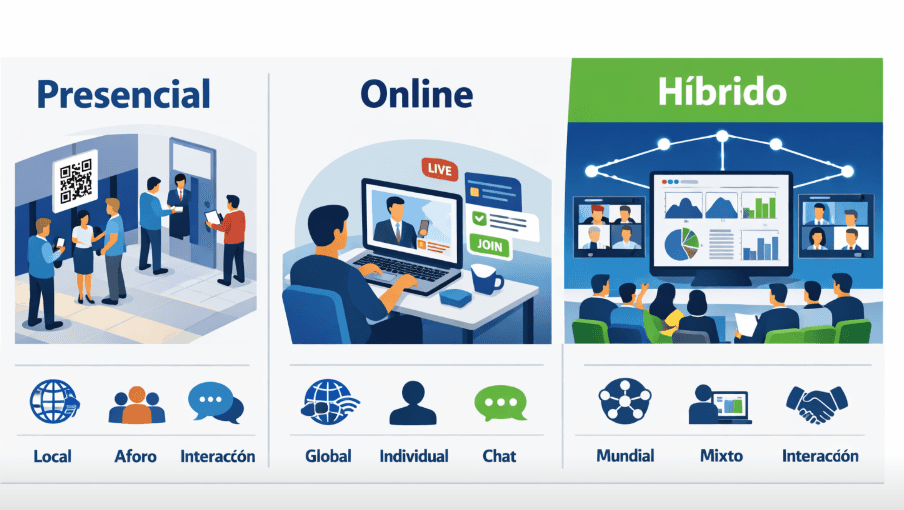
Before deciding on a hybrid format, you need to understand which context each model performs best in. Not all events justify the investment of combining in-person and online.
Criteria | In-Person | Online | Hybrid |
|---|---|---|---|
Geographic reach | Limited to venue | Unlimited | Unlimited + local experience |
Audience capacity | Defined by venue capacity | Virtually unlimited | Physical capacity + remote audience |
Attendee interaction | High (natural networking) | Medium (platform dependent) | High in-person + moderate online |
Operational complexity | Standard | Low-medium | High (two simultaneous experiences) |
Revenue sources | Tickets + sponsors | Tickets + sponsors + recorded content | All of the above combined |
Attendee data | Partial (system dependent) | Complete (digital registration) | Complete for both audiences |
Content shelf life | Ends with the event | Reusable recording | Recording + in-person experience |
When does hybrid format make sense?
It makes sense when your event meets at least two of these conditions: you have potential audience outside your city or country, the content has value beyond the live moment, you want to maximize revenue with different ticket tiers (in-person, streaming, on-demand), or you need unified data from all attendees for subsequent remarketing.
It doesn't make sense when the event is purely experiential and losing the in-person element removes all value (for example, a wine tasting or food festival where the value lies in sampling). Also not recommended if your team lacks the technical capacity to manage two simultaneous experiences without sacrificing quality.
The 7 most common mistakes when organizing hybrid events
Most organizers attempting hybrid format for the first time make completely avoidable mistakes. Here are the most frequent ones and how to avoid them:
1. Treating the online audience as second-class spectators. If the remote audience only sees a fixed camera pointing at the stage, you're not doing a hybrid event. You're doing an in-person event with a stream. The online audience needs its own experience: dedicated moderator, active chat, exclusive content, or access to recordings.
2. Using one ticket type for both formats. A hybrid event needs, at minimum, two differentiated ticket categories: in-person and online. Ideally, you can add intermediate levels (VIP in-person, online with replay access, in-person + recording combo). Using a single category creates confusion and makes you lose monetization opportunities.crear un evento con categorías diferenciadas
3. Not unifying the database. If you sell in-person tickets through one channel and online tickets through another, you end up with two databases that don't communicate. When you want to do remarketing for the next event, you have an operational disaster. The solution is using a single ticketing platform that manages both ticket types from the same dashboard.
4. Ignoring post-event remarketing. The event is over, but your relationship with attendees isn't. The data you collected (who bought, what ticket type, whether they attended) is gold for your next event. Without an automated remarketing system, that data sits in a CSV nobody looks at.
5. Not measuring conversion by channel. How many online tickets did you sell through Instagram? How many in-person through email? If you don't integrate tracking pixels (Meta Pixel, GA4) into your sales process, you're making decisions blindly.
6. Complicating the checkout. Every extra step in the purchase process increases abandonment. If your online attendee has to create an account, fill extensive forms, and navigate a confusing checkout, you'll lose sales. Same applies to in-person tickets sold online.
7. Selling from a domain that isn't yours. When your audience clicks "Buy tickets" and lands on a marketplace site, they leave your ecosystem. They lose track of your brand, your tracking breaks, and you lose data. Selling from your own domain isn't an aesthetic whim: it's a strategic decision that impacts conversion, SEO, and loyalty.
How to sell hybrid events with white-label ticketing
This is where operations get concrete. Selling tickets for a hybrid event requires a ticketing platform that resolves the complexity of managing two distinct audiences without duplicating your work.
A white-label ticketing platform like Fanz lets you do exactly that. Here's how it works in practice:
Own domain and complete branding. Your event lives on your URL (for example: tickets.yourevent.com). The buyer, whether in-person or online, purchases from your brand. The checkout, confirmation emails, and tickets carry your logo, your colors, and your identity. Fanz operates invisibly in the backend. This capability is available for organizers in over 50 countries.
Differentiated ticket categories. From the same dashboard, you create all the ticket types you need: general in-person, VIP in-person, online streaming, online with replay, combos, early bird. Each with its quota, description, and specific configuration.
Direct collection through Stripe. Each sale goes directly to your Stripe account. No financial intermediaries or delayed settlements. You sold a ticket, the money is already available. For hybrid events with elevated production costs (streaming platform, technical equipment, venue), this immediate liquidity is critical.
Web QR validation for in-person audience. In-person attendees receive a QR code that validates from any device with a web browser. No need to install special apps or dedicated hardware. The system records who entered, at what time, and with what ticket type.
Emails with your own brand. Purchase confirmation, 24-hour reminder, post-event communications: everything comes from your inbox, with your design. Your attendee (in-person or online) never sees a third party's name in their inbox.
Unified analytics. From a single dashboard, you see in-person and online sales, conversion rates, acquisition channels, and purchase behavior. No need to cross-reference spreadsheets from different platforms.
Automated AI remarketing. This is what separates basic ticket sales from a growth strategy. Fanz's system identifies users who visited your page without buying and automatically targets them with remarketing campaigns. It also triggers abandoned cart emails and personalized sequences. For hybrid events, where potential audience is broader (anyone with internet is a possible online attendee), automated remarketing multiplies your reach without multiplying your work.
Checklist for organizing a successful hybrid event
Use this list before, during, and after your event. Each item is actionable:
Pre-event (planning)
Define differentiated value proposition for in-person and online audiences
Create separate ticket categories (minimum: in-person + online)
Configure sales on a ticketing platform with own domain and editable branding
Activate direct collection through Stripe for immediate liquidity
Integrate tracking pixels (Meta Pixel, GA4) into checkout
Configure automatic emails: confirmation, 24-hour reminder, post-event
Activate automatic remarketing to recover abandoned carts
Test complete purchase flow on mobile (over 70% of traffic comes from mobile)
Designate exclusive moderator for online audience
During the event
Validate in-person access with web QR at the door
Monitor real-time attendance from analytics dashboard
Maintain active communication with online audience (chat, polls, Q&A)
Record content for post-event use
Post-event
Analyze metrics: tickets sold by type, attendance rate, acquisition channels
Export complete attendee database (in-person + online)
Execute remarketing campaign to attendees for next event
Send differentiated satisfaction survey (in-person vs. online)
Evaluate: did hybrid format generate more revenue than in-person only or online only?
What exactly is a hybrid event?
A hybrid event combines in-person attendees at a physical venue with an audience participating remotely through streaming or another digital platform. Both audiences access the same content but with experiences adapted to each format.
Are hybrid events more expensive to organize than in-person events?
They have additional costs related to streaming production (cameras, platform, technical equipment), but they also open revenue sources that in-person format alone doesn't allow: online tickets, post-event on-demand content, and unlimited geographic reach that expands your potential market.
Can I sell in-person and online tickets from the same platform?
Yes, if you use a ticketing platform that allows creating multiple ticket categories from the same dashboard. With a white-label ticketing platform like Fanz, you manage in-person and online in one place, with unified analytics and remarketing for both audiences.
How do I avoid the online audience feeling like "second-class spectators"?
Design a specific experience for them: dedicated moderator, active chat, access to recordings, exclusive digital material, virtual networking sessions. The key is that the online ticket has its own value, not that it's simply "watching what happens in the room".
What percentage of my audience should I expect online vs. in-person?
It depends on event type, but as a general reference, many conference and congress organizers report that online audience can represent between 30% and 60% of total when content has high educational or professional value. More experiential events tend to concentrate a higher in-person proportion.
Do I need an app to validate in-person tickets at a hybrid event?
Not necessarily. Web-based QR validation systems exist that work from any device with a browser, without requiring installation of additional applications or specialized hardware.
How do I measure the success of a hybrid event?
Key metrics are: tickets sold by type (in-person vs. online), effective attendance rate in each format, total revenue compared to in-person only format, online audience engagement (time spent, interactions), and post-event remarketing conversion rate.
Can I do differentiated remarketing for in-person and online attendees?
Yes, as long as your ticketing platform unifies the database and allows you to segment by ticket type. With a remarketing tool that integrates with your ticketing system, you can create specific campaigns for each audience segment based on their participation preferences and behaviors.
Tags